Why is there a urine sample in the museum? Five lingering stories from BORDERS
How do you experience an exhibition when you’ve been working on it behind the scenes for months? We asked former MuST member and ex-intern Robbe Rooms to choose five objects that moved him the most. Below, he takes you on a tour in BORDERS.
In October, I started an internship at GUM & Botanical Garden, which will come to an end a month after the opening of BORDERS. The exhibition opening was the highlight for me, especially as I was heavily involved in the communications surrounding it. As the icing on the cake of my work placement, I selected five objects and stories that I find most important, most beautiful or most inspiring. I hope you’ll see the beauty in them too.
Who am I?
My name is Robbe Rooms and I’ve just completed a six-month work experience placement at GUM & Botanical Garden, where I focused primarily on digital communication. As part of this, I created web pages, newsletters and social media content. The opening of a new exhibition is, of course, a key moment for communications, so, together with my communications colleagues, I immersed myself in the ‘BORDERS’ exhibition to promote it as effectively as possible online. To this end, I proofread all the texts multiple times and closely monitored the physical set-up, so that we could give our audience the occasional sneak peek on social media.
Before I started my placement, I was a member of MuST, the Museum Student Team at GUM & Plantentuin, for four years. There, I not only gained a rich insight into the museum’s behind-the-scenes workings, but was also allowed to take part in brainstorming sessions for the BORDERS exhibition – which was still a long way off at the time – for almost two years before its opening. Every now and then, we at MuST would receive an update on the development process of BORDERS, which I’ve experienced much more intensively over the last few months. The exhibition comprises over a hundred objects, artworks and stories, so it goes without saying that some appeal to me more than others. As a sort of epilogue to my work placement, I’m now sharing some of my favourite stories from BORDERS, and explaining why these stand out for me.
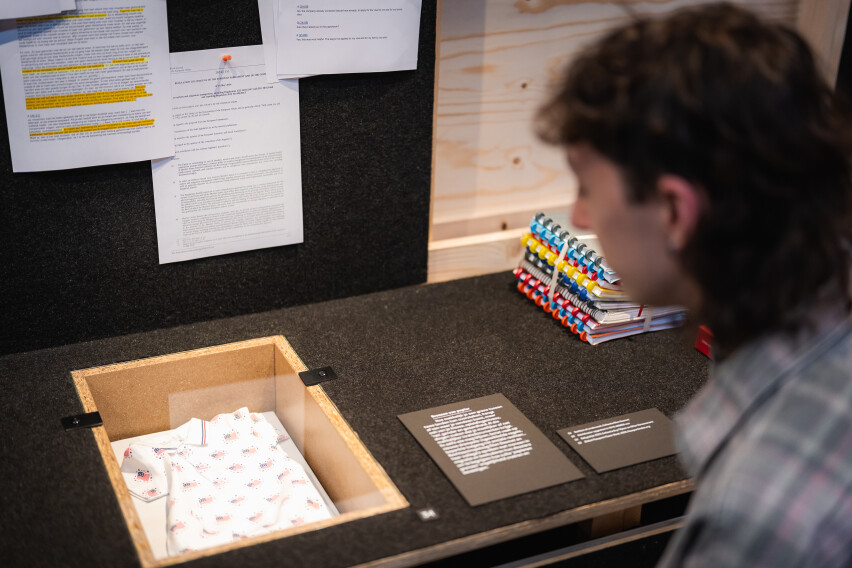
Baby outfit by Guy T'sjoen and Milan Vansevenant
If you’re someone’s child, surely that’s the case everywhere? Well, not always. The baby outfit on display at BORDERS belongs to the child who was adopted by Guy T’sjoen and Milan Vansevenant. They adopted the child from a surrogate mother in California, whereby they both became the child’s official fathers under the law there. However, when they returned to Belgium with the child, that was no longer the case. Under Belgian law, a child cannot officially have two fathers (if a surrogate mother is involved, the non-biological parent is asked to adopt the child).
However, cities and municipalities have the power to ‘override’ this law. That is what they did in Ghent, where Guy and Milan live. They made the courageous decision to recognise the reality of families with same-sex parents. So Guy and Milan are now both dads to their child, but the story does make you think about boundaries. About how legislation influences relationships and how relationships can vary depending on where you are. It sounds a bit surreal to me. Finally, it also strikes me that the legislation in California is more progressive in this regard than that of Belgium. It’s strange, because we always assume that Belgium is quite progressive and the US more conservative than us.
Urine sample
Yes, there’s wee in the museum. Strange, isn’t it? Or is it just strange that we find that strange? Many people might even find it a bit grubby or even inappropriate. We often see urine as something that’s dirty. It may well be waste from our bodies, but it’s also very universal. We all visit the loo several times a day, and yet it’s a bit of a taboo. The urine on display here belongs to the Dutch curator Ruben Verwaal. He’s conducting research into bodily fluids, but couldn’t find any in the collections of science museums. So he donated one of his own bodily fluids to those collections.
This urine sample – which, incidentally, is now more than ten years old – forms part of the first section of BORDERS: OTHER(ING). This section of the exhibition explores the boundaries of our own selves, such as those of our bodies. Is urine part of our body? We produce it ourselves, but flush it down the toilet and walk away from it. Before I go to the loo, my wee is part of my body, but is that wee still part of me after I’ve flushed it away? I’ve been thinking about it (too) much lately, and yes, especially when I’m sitting on the loo...
Model of a urinal
To stay in a similar vein for a moment, I look at the model of a urinal standing directly opposite the urine sample. It is a scale model of a urinal like those that used to appear in Ghent. Just as with most urinals today, there is a low wall around the public toilet to provide some privacy, but not too much. The walls stand on legs, allowing passers-by (and passing police) to easily see how many people are inside the toilet cubicle. This is a solution to a problem that arose with earlier designs, where the partition wall extended all the way to the floor.
The fact was that in Ghent (unlike in various other cities), there used to be no pubs that gay men used to meet up. Public toilets offered an easy solution for having a bit of fun with (unknown) men. The question, of course, was how you knew who was open to a joint visit to the toilet; with whom could you cross a certain line? For this, there were secret gestures or codes, such as the ‘hanky code’, where a coloured handkerchief hinted at the sexual act you were looking for. Access codes like these create a safer environment or sense of security, resulting in a safe(r) space where a boundary is drawn between people who belong to a particular group and those who do not. I don’t use these public toilets or the hanky code myself, but I do attach great importance to safe(r) spaces where I can feel safe and free together with my friends and community.
The Endless Wall by Hamada Elkept
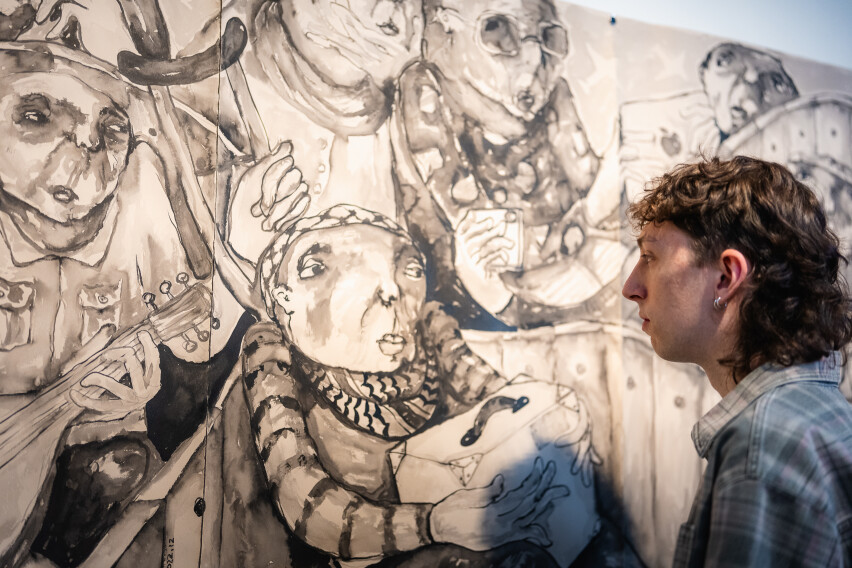
BORDERS also features various works of art, and The Endless Wall by Hamada Elkept really stands out for me. The artist lives in Brussels and is originally from Palestine. In the painting, we see various people engaged in all sorts of activities: using an iPad, playing a musical instrument or smoking. There are walls between the people and, although they can see one another, nobody seems to be interacting with anyone else. With this, Hamada Elkept alludes to the Israeli separation wall along and within the West Bank.
For me, there is also a great deal of symbolism behind it. I see in this that people do not form connections with one another, but remain preoccupied with their own worlds, within their own bubbles. It shows how we sometimes live in isolation from one another. We do move alongside one another, but we are not open enough to one another. As a result, we do not know one another well, we do not understand one another well, and some people see ‘the Other’ as a threat or even an enemy. Not knowing one another well is not necessarily a problem, I think, but failing to show understanding or respect for others leads to friction, problems and inequality.
Trans – Et alors? by Lieve Blancquaert
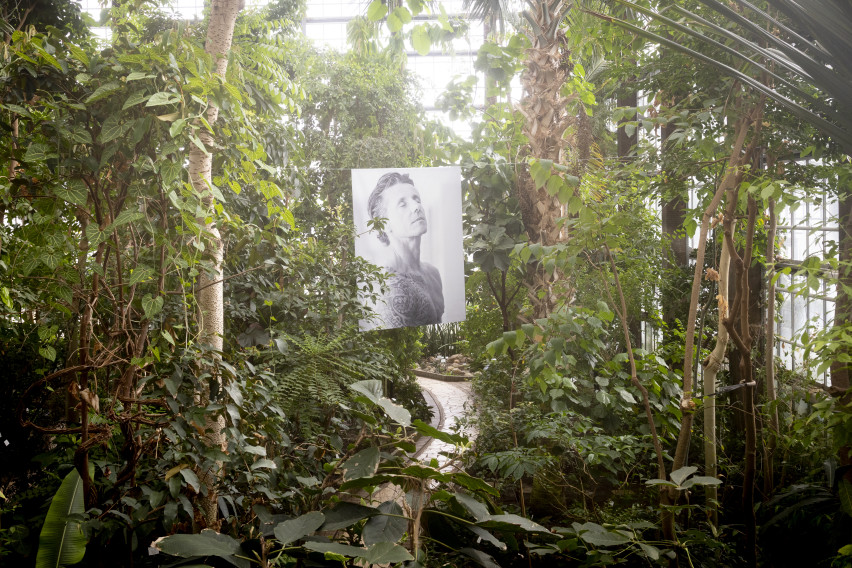
Finally, I’d like to take you to the green houses in the Botanical Garden, because BORDERS isn’t just in the museum. The Botanical Gardens are also an inspiring and peaceful place where art can be exhibited. Here hangs another of my favourite artworks from the BORDERS exhibition. Or rather, it isn’t really a single object, as it consists of six photographs on display here. These are photographs taken by Lieve Blancquaert for the book Trans – Et alors? by Piet Hoebeke and Marijke Libert. The portraits depict trans people in a truly beautiful way. What appeals to me most is how gentle, tender and intimate the photographs feel, as if you were actually right there with these people. The photographs of Joppe and Maliqua, in particular, have an almost magical quality, which instantly lifts my spirits.